Yoga is one of the best ways to improve flexibility, mobility, balance, and body awareness. If you are a beginner, you do not need to be naturally flexible or able to perform advanced poses. With regular practice and gentle stretching, you can gradually improve your range of motion and feel more comfortable in everyday movements.
This beginner-friendly full-body yoga routine focuses on the major muscle groups, including the neck, shoulders, back, hips, hamstrings, and legs. You can practice it at home with a yoga mat and a few simple yoga accessories such as blocks or a strap.
Why Is Flexibility Important?
Flexibility allows your muscles and joints to move through a comfortable range of motion. Better flexibility can support good posture, easier movement, and overall mobility.
Regular yoga practice may help you:
- Improve overall flexibility
- Reduce muscle tightness
- Increase mobility and balance
- Improve posture and body awareness
- Relax the body and mind
- Support better movement during exercise and daily activities
Remember that flexibility develops gradually. Avoid forcing your body into a position simply to reach a deeper stretch.
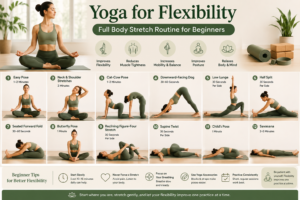
Full-Body Yoga Stretch Routine for Beginners
1. Easy Pose – 1 to 2 Minutes
Begin by sitting comfortably on your yoga mat with your legs crossed. Keep your spine naturally upright and relax your shoulders.
Take slow, deep breaths. As you inhale, lengthen your spine. As you exhale, allow your shoulders and body to relax.
This simple position helps you prepare your body and mind for the practice.
2. Neck and Shoulder Stretches – 2 Minutes
Sit or stand comfortably. Slowly tilt your head toward your right shoulder, then return to the center and repeat on the left side.
Next, gently turn your head from side to side. Follow this with slow shoulder rolls forward and backward.
Keep the movements controlled and avoid making sudden or forceful movements.
3. Cat-Cow Pose – 1 to 2 Minutes
Come onto your hands and knees with your wrists under your shoulders and knees under your hips.
As you inhale, gently lift your chest and tailbone while allowing your back to curve naturally. As you exhale, round your spine and gently draw your abdomen inward.
Continue slowly for several repetitions.
Cat-Cow is a beginner-friendly movement that helps warm up the spine and back.
4. Downward-Facing Dog – 30 to 60 Seconds
From your hands and knees, lift your hips upward and back to create an inverted V shape.
Keep your knees slightly bent if your hamstrings feel tight. Focus on lengthening your spine rather than forcing your heels toward the floor.
Take several slow breaths while relaxing your neck and shoulders.
5. Low Lunge – 30 Seconds Per Side
Step your right foot forward between your hands and gently lower your left knee toward the mat.
Keep your front knee comfortably positioned and slowly shift your hips forward until you feel a gentle stretch around the hip area.
Hold for several breaths, then switch sides.
6. Half Split – 30 Seconds Per Side
From the low lunge position, slowly move your hips backward and straighten your front leg as comfortably as possible.
Keep your spine long and avoid rounding your back excessively. You should feel a gentle stretch along the back of your front leg.
Repeat on the opposite side.
7. Seated Forward Fold – 30 to 60 Seconds
Sit with your legs extended in front of you. Keep your spine long and slowly hinge forward from your hips.
Do not worry about touching your toes. If your hamstrings are tight, keep your knees slightly bent.
The goal is to feel a comfortable stretch rather than forcing yourself deeper into the pose.
8. Butterfly Pose – 1 Minute
Sit comfortably and bring the soles of your feet together. Allow your knees to move gently toward the sides.
Hold your feet or ankles and sit tall. You can gently lean forward if it feels comfortable.
Butterfly Pose is a simple stretch for the inner thighs and hips.
9. Reclining Figure-Four Stretch – 30 Seconds Per Side
Lie comfortably on your back and bend both knees.
Place your right ankle over your left thigh. Slowly draw your left leg toward your chest until you feel a gentle stretch around your right hip.
Hold for several breaths and then switch sides.
10. Supine Twist – 30 Seconds Per Side
Lie on your back with your knees bent. Gently lower both knees toward one side while keeping your shoulders relaxed on the mat.
Turn your head in whichever direction feels comfortable.
Hold for a few slow breaths, then repeat on the opposite side.
11. Child’s Pose – 1 Minute
Kneel on your mat and gently lower your hips toward your heels. Extend your arms forward or rest them comfortably beside your body.
Relax your shoulders and breathe slowly.
Child’s Pose is a calming way to finish your stretching routine.
12. Savasana – 2 to 5 Minutes
Lie flat on your back with your arms resting comfortably beside you.
Close your eyes and take slow, relaxed breaths. Allow your entire body to become still.
Use this final relaxation period to notice how your body feels after the practice.
Beginner Tips for Better Flexibility
Start Slowly
You do not need to complete a long yoga session when you are starting. Even 10–15 minutes of regular practice can help you build consistency.
Never Force a Stretch
A gentle pulling sensation can be normal, but sharp pain is a signal to stop or reduce the intensity. Yoga should not be about forcing your body into a particular shape.
Focus on Your Breathing
Slow breathing can help you stay relaxed during stretching. Try to breathe naturally instead of holding your breath.
Use Yoga Accessories
Yoga blocks and straps can make beginner poses more comfortable and accessible. A block can provide support when your hands cannot comfortably reach the floor, while a strap can help you maintain a position without overstretching.
Practice Consistently
Flexibility usually improves through consistent practice rather than occasional intense stretching. Aim for a few short sessions each week and gradually increase your practice time.
How Often Should Beginners Practice Yoga for Flexibility?
For beginners, practicing yoga around 3–5 times per week can be a practical goal. You can start with short sessions and gradually increase the duration as your body becomes more comfortable.
Consistency is more important than doing difficult poses. Give your body enough time to recover, especially if you are also doing strength training or other forms of exercise.
Final Thoughts
Yoga for flexibility does not require advanced skills or extreme flexibility. A simple full-body routine can help beginners gently work on mobility while developing better body awareness and relaxation.
Start with comfortable stretches, breathe steadily, and progress gradually. With regular practice, patience, and proper technique, you can build flexibility and make movement feel easier and more natural.
Start where you are, stretch gently, and let your flexibility improve one practice at a time.